
Public Comment Regarding NPRM from LSF CEO, Mike Carroll
To submit your own public comment, please click here.
To the U.S. Department of Health and Human Services:
For more than four decades, Lutheran Services Florida (LSF) has built its work around a simple responsibility: When children and families need us, we show up.
Today, LSF is one of Florida’s largest Head Start providers. I have the privilege of leading an organization whose teachers, family service professionals and program teams show up every day for children and families across our state. What happens inside those classrooms makes one thing clear: Head Start works because preparing a child for life requires more than preparing that child academically.
That is why I am concerned about the potential impact of the proposed rewrite of the Head Start Program Performance Standards.
I believe in accountability and responsible stewardship. I also believe we should challenge requirements that create paperwork and checklists without creating better outcomes. If federal processes take our people away from serving families without adding meaningful value, we should be willing to change them.
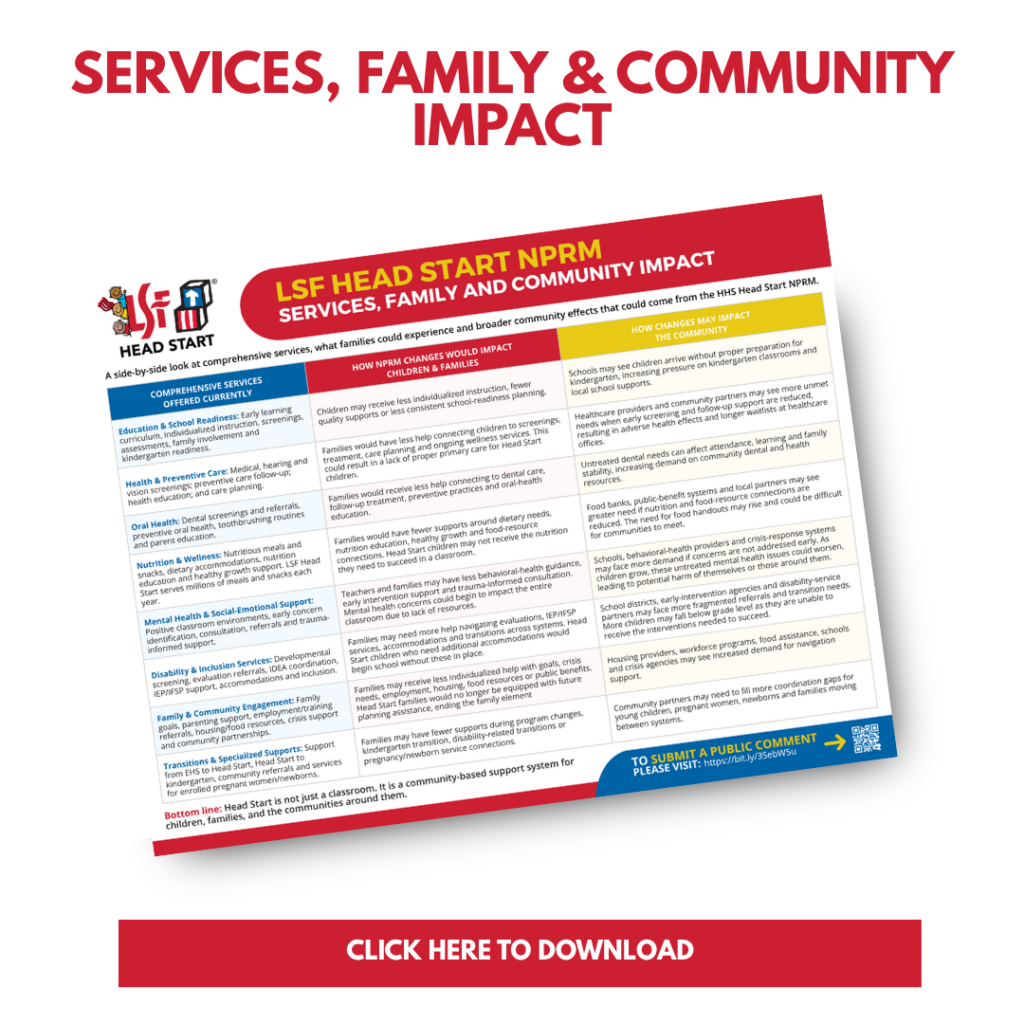
But we must be equally willing to protect what works. Head Start has never been just preschool. Education, health, mental health, nutrition, disability services and family engagement work together around the child and family. Together, they are what make Head Start effective.
As I review this proposal, my concern is not simply that federal requirements may disappear. My concern is what could disappear with them. I want to believe this proposal is rooted in a desire to strengthen Head Start, reduce unnecessary burden and give local leaders greater freedom to serve their communities well.
But I also cannot ignore what these changes could mean when taken together. The proposed reduction of services and supports for children and families, combined with a drastic reduction in the allowable administrative rate, raises a much larger concern for me about the future of Head Start itself.
I fear these changes could fundamentally weaken Head Start to the point that the program we are left with no longer resembles the comprehensive model that has changed the trajectory of millions of children and families’ lives.
If programs are expected to operate with fewer supports, fewer consistent protections and dramatically fewer resources to administer increasingly complex organizations, we should ask plainly whether we are reforming Head Start or creating conditions that could ultimately dismantle it as we know it.
A staff-child ratio affects what a teacher can provide to every child in the room. Mental health support can provide critical expertise when a child, family or classroom is struggling. A family services professional can be the person sitting across from a parent during one of the hardest moments that family has faced, helping them find a path forward.
The children we serve through this program have disproportionately encountered trauma and other earl childhood challenges. These types of services may appear as bureaucratic regulations for some, but for others, they are survival mechanisms.
A standard can look very different from Washington than it does inside a Head Start center. We should not confuse permission to do less with a reason to do less. The removal of a federal requirement does not remove the value that practice may have for a child or family.
At LSF, we will continue asking the harder question: Does this help us serve children and families better?
If a practice exists only to satisfy a process that produces no meaningful benefit, we should reconsider it. But if it keeps a child safe, supports a teacher, strengthens a parent, identifies a developmental need or helps a child enter school ready to succeed, its value does not disappear because a federal regulation does.
I want Head Start to reach more children. Every eligible child we cannot currently serve represents an opportunity we should be working to create. But serving more children is not enough. We must serve them well. More children receiving less will never be our measure of success.
For generations, Head Start has changed trajectories because it looks at the whole child and the whole family. It understands that children cannot leave hunger, health concerns, developmental needs or instability at the classroom door. It understands that strengthening a parent strengthens a child. The comprehensive, two-generational approach is one worth protecting.
I urge HHS to listen to the teachers, family service professionals, program leaders and, most importantly, parents who understand what these standards mean in practice. They can identify requirements that create burden without value. They can also identify the standards that protect something important for children and families.
LSF will always look for ways to improve, operate responsibly and use resources wisely. Flexibility that helps us do that work better will always be welcomed. But the goal cannot be to do less simply because we are permitted to do so.
I urge HHS to preserve a strong federal foundation for Head Start that protects quality, accountability and comprehensive services while providing thoughtful flexibility where it can genuinely improve outcomes. Protect what works. Improve what does not. And never lose sight of the people behind the statistics.
The children and families who depend on Head Start deserve our very best.
To submit your own public comment, please click here.